Sebastian Mayrhofer
Nicola Reiter
Johannes Vogl
Ulrich Vogl
Sonja Wahler
long time no see
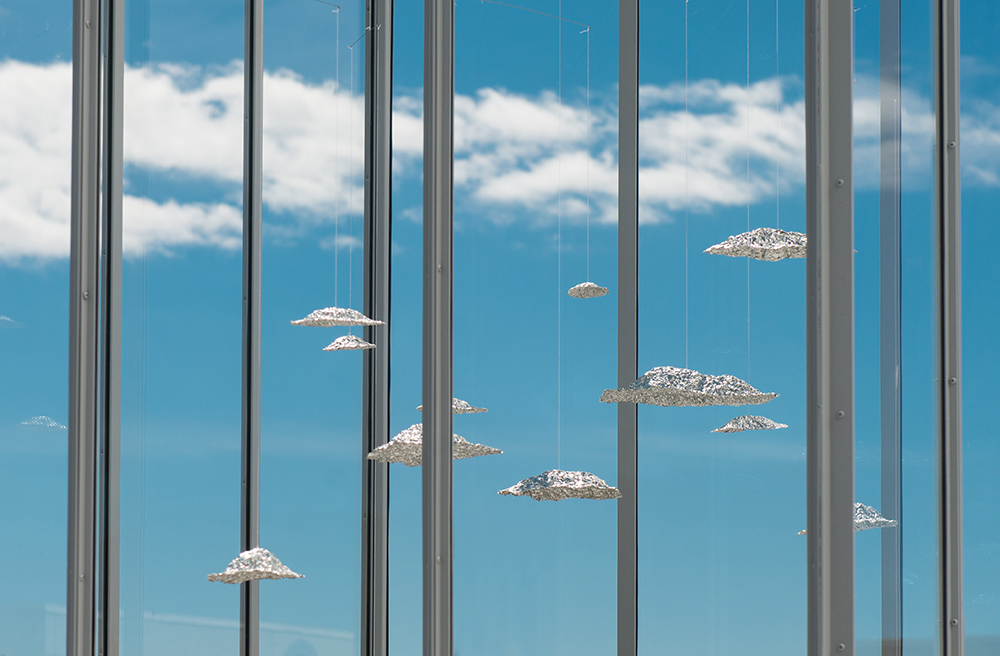
Ulrich Vogl "Wolkenhaus", 2013, Foto: Erik Joergensen
Programme & Events
To mark its 30th anniversary, the Kunsthaus Kaufbeuren sent out a chain letter. Six cultural figures from the region were invited to name six artists whose work they would like to see for the first time or once again in an exhibition at the Kunsthaus. All of the artists have a connection to the Allgäu region, either because they live or grew up here, or though they have long since moved away to live and work elsewhere. This invitation process highlights a wide-ranging network of cultural figures from different disciplines and generations, resulting in an exhibition that combines various references and personal connections to offer unusual perspectives on the region.
Opening on Saturday, March 14, at 4 p.m.
In the foyer of the Kunsthaus Sonja WahIer1 displays photos, drawings, prints, and found objects from her research and search for traces on the former site of the Rosenbrauerei brewery in Kaufbeuren, which she undertook there in 2020. In March 2022, the former brewery building burned down. The site of the search for traces no longer exists. In Sonja Wahlers' installation, transparent image carriers overlap, creating new connections, and details become blurred like long-forgotten memories. The collected material becomes the starting point for speculative research and a search for what forgetting looks like.
Ulrich Vogl´s2 sculpture Wolkenhaus (Cloud House) stood in the public space at Salzmarkt in Kaufbeuren from 2014 onwards and was the subject of controversial debate before it was dismantled in 2016 as part of redevelopment measures in the pedestrian zone there. In the exhibition space, individual elements of the sculpture, together with other materials and motifs, form a walk-in installation that invites visitors to reflect on the relationship between shared public space and institutional spaces in terms of discourse and participation.
Johannes Vogl3 creates idiosyncratic sculptures from everyday objects that visualize poetic images. His expansive sculpture Walze (Roller) is reminiscent of agricultural equipment. Equipped with 138 shoes, it apparently serves to create a trail of hundreds of footprints and refers to people in motion, demonstrators, refugees, military marches, to fleeting moments that often indicate far-reaching changes and upheavals.
Sebastian Mayrhofer4 intentionally combines various materials, techniques, and media in his installations, drawings, videos, and performances. His new installation dreh dich ganz langsam (turn very slowly) features wooden masks and videos. Unlike the garish grimaces of the Perchten in local customs, the figures here move cautiously, wanting to remain unnoticed, to hide, to blend into the surrounding landscape and its temporality.
In his interdisciplinary practice, which encompasses photography, ceramics, drawing, painting, and performance, Maximilian Gutmair5 combines themes such as queerness, emotion, nature, and spirituality. His towering ceramic fountain sculpture references and transforms motifs from various belief systems with baroque opulence—as a tribute to all that is alive, proliferating, and natural—to connections and transitions between organic matter, plants, animals, and human bodies.
Designer and artist Nicola Reiter6 is exhibiting her long-term project Afdərmähdag in the Kunsthaus Speicher. Since 2020, she has been taking photographs on walks around her home in Oberallgäu that capture traces of agricultural work. Through her images and conversations with farming families about their farms and activities, she explores the structures, conditions, and transformations of working environments, as well as the relationship between people, farm animals, and cultural landscapes. After the initial phase, the project will be expanded and continued from the end of July until November 2026.
Proposed by:
1 Martin Valdés-Stauber (Dramaturg, Schaubühne Berlin)
2 Nadja Ostertag (theatre educator, Kulturwerkstatt Kaufbeuren)
3 Thomas Garmatsch (theatre educator, Kulturwerkstatt Kaufbeuren)
4 Tatjana Nocker (Architect and museum educator, querKUNST Kaufbeuren)
5 Luise Wank (curator, Berlin)
6 Frauke Zabel (Artist and art educator, Kunstuniversität Linz)
funded by